
Frank Rich and the NYT – why neither can be taken seriously
My friend Les passed along this article written by Slate’s Deputy editor David Plotz, in response to an opinion piece posted by Frank Rich, columnist for the NYT, on September 10th. The actual column is behind the “Times Select” wall, but I did find a copy of it here after a Google search, so that’s my reference point. It’s titled “Whatever Happened to the America of 9/12?” Rich writes:
The destruction of post-9/11 unity, both in this nation and in the world, is as much a cause for mourning on the fifth anniversary as the attack itself.
“THE most famous picture nobody’s ever seen” is how the Associated Press photographer Richard Drew has referred to his photo of an unidentified World Trade Center victim hurtling to his death on 9/11. It appeared in some newspapers, including this one, on 9/12 but was soon shelved. “In the most photographed and videotaped day in the history of the world” Tom Junod later wrote in Esquire, “the images of people jumping were the only images that became, by consensus, taboo.”
Five years later, Mr. Drew’s “falling man” remains a horrific artifact of the day that was supposed to change everything and did not. But there’s another taboo 9/11 photo, about life rather than death, that is equally shocking in its way, so much so that Thomas Hoepker of Magnum Photos kept it under wraps for four years. Mr. Hoepker’s picture can now be found in David Friend’s compelling new 9/11 book, “Watching the World Change” or on the book’s Web site, watchingtheworldchange.com. It shows five young friends on the waterfront in Brooklyn, taking what seems to be a lunch or bike-riding break, enjoying the radiant late-summer sun and chatting away as cascades of smoke engulf Lower Manhattan in the background.
Mr. Hoepker found his subjects troubling. “They were totally relaxed like any normal afternoon” he told Mr. Friend. “It’s possible they lost people and cared, but they were not stirred by it.” The photographer withheld the picture from publication because “we didn’t need to see that, then.” He feared “it would stir the wrong emotions.” But “over time, with perspective” he discovered, “it grew in importance.”
Seen from the perspective of 9/11’s fifth anniversary, Mr. Hoepker’s photo is prescient as well as important — a snapshot of history soon to come. What he caught was this: Traumatic as the attack on America was, 9/11 would recede quickly for many. This is a country that likes to move on, and fast. The young people in Mr. Hoepker’s photo aren’t necessarily callous. They’re just American. In the five years since the attacks, the ability of Americans to dust themselves off and keep going explains both what’s gone right and what’s gone wrong on our path to the divided and dispirited state the nation finds itself in today.
Here’s the photo in question:
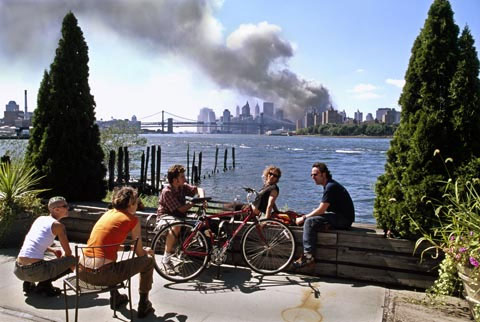
(c) Copyright: Thomas Hoepker/Magnum Photos
Poltz, not buying Rich’s criticism of the people in the photo, wrote this in response:
But wait! Look at the photograph. Do you agree with Rich’s account of it? Do these look like five New Yorkers who are “enjoying the radiant late-summer sun and chatting away”? Who have “move[d] on”? Who—in Rich’s malicious, backhanded swipe—”aren’t necessarily callous”? They don’t to me. I wasn’t there, and Hoepker was, so it may well be that they were just swapping stories about the Yankees. But I doubt it. The subjects are obviously engaged with each other, and they’re almost certainly discussing the horrific event unfolding behind them. They have looked away from the towers for a moment not because they’re bored with 9/11, but because they’re citizens participating in the most important act in a democracy—civic debate.
Ask yourself: What are these five people doing out on the waterfront, anyway? Do you really think, as Rich suggests, that they are out for “a lunch or bike-riding break”? Of course not. They came to this spot to watch their country’s history unfold and to be with each other at a time of national emergency. Short of rushing to Ground Zero and digging for bodies, how much more patriotic and concerned could they have been?
So they turned their backs on Manhattan for a second. A nice metaphor for Rich to exploit, but a cheap shot. I was in Washington on 9/11. I spent much of the day glued to my TV set, but I also spent it racing home to be with my infant daughter, calling my parents and New York relatives, and talking, talking, talking with colleagues and friends. Those discussions were exactly the kind of communal engagement I see in this photo. There is nothing “shocking” in this picture. These New Yorkers have not turned away from Manhattan because they have turned away from 9/11. They have turned away from Manhattan because they have turned toward each other for solace and for debate.
Poltz put out a call for anyone from the photo to email him to share their recollection about what they were doing in the photo. One person has indeed responded (identity verified). His name is Walter Sipser, a Brooklyn artist and the man on the far right in the photo. He wrote this to Poltz via email:
A snapshot can make mourners attending a funeral look like they’re having a party.
Thomas Hoepker took a photograph of my girlfriend and me sitting and talking with strangers against the backdrop of the smoking ruin of the World Trade Center on September 11th. Earlier, she and I had watched the buildings collapse from my rooftop in Brooklyn and had made our way down to the waterfront. The Williamsburg Bridge was filled with hundreds of people, covered in dust, helping one another make their way onto the street. It was clear that people who ordinarily would not have spoken two words to each another were suddenly bound together, which I suppose must be a fairly common occurrence in the aftermath of a catastrophe.
We were in a profound state of shock and disbelief, like everyone else we encountered that day. Thomas Hoepker did not ask permission to photograph us nor did he make any attempt to ascertain our state of mind before concluding five years later that, “It’s possible they lost people and cared, but they were not stirred by it.” Had Hoepker walked fifty feet over to introduce himself he would have discovered a bunch of New Yorkers in the middle of an animated discussion about what had just happened. He instead chose to publish the photograph that allowed him to draw the conclusions he wished to draw, conclusions that also led Frank Rich to write, “The young people in Mr. Hoepker’s photo aren’t necessarily callous. They’re just American.” A more honest conclusion might start by acknowledging just how easily a photograph can be manipulated, especially in the advancement of one’s own biases or in the service of one’s own career.
Indeed.
What I find more interesting than Rich’s blind acceptance of Hoepker’s assertions about the people in the photo is the fact that the photo wasn’t included in the article itself (I know this thanks to my friend Les, who has viewed the article from beyond the Times Select wall) so anyone curious enough would have had to actually go the website itself to find and view it or buy the book to see it. Rich gives the impression that the photo is so awful, that it is not fit to publish in the NYT. This is at odds with the NYT’s decision to post the photos of American civilian contractors who were ambushed burned, mutilated, and hung from a bridge over the Euphrates River in Fallujah, Iraq back in March 2004.
So posting pictures of mutilated and charred bodies is ok because we ‘need to see for ourselves’ what’s going on in Iraq (which I agree with), but posting a picture of five people having a conversation that was assumed to be a ‘casual one, unrelated to the WTC’ should be considered ‘taboo’ (which I don’t agree with).
Got it.