
Sister Toldjah!
5/23/2007 - 11:24 pm

Here (sub. req’d) is what the slick Senator from North (or is it South?) Carolina won’t tell you on his campaign stops where he discusses ‘declining wages’ (emphasis added):

It’s been a rough week for John Edwards, and now comes more bad news for his “two Americas” campaign theme. A new study by the Congressional Budget Office says the poor have been getting less poor. On average, CBO found that low-wage households with children had incomes after inflation that were more than one-third higher in 2005 than in 1991.

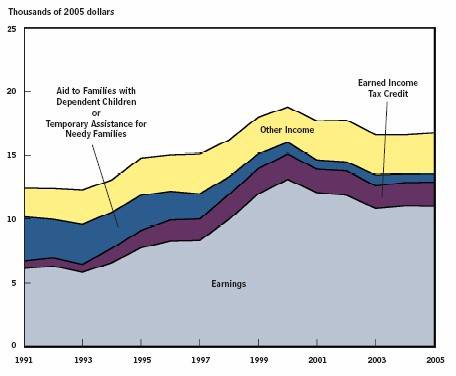
The CBO results don’t fit the prevailing media stereotype of the U.S. economy as a richer take all affair — which may explain why you haven’t read about them. Among all families with children, the poorest fifth had the fastest overall earnings growth over the 15 years measured. (See the nearby chart.) The poorest even had higher earnings growth than the richest 20%. The earnings of these poor households are about 80% higher today than in the early 1990s.

What happened? CBO says the main causes of this low-income earnings surge have been a combination of welfare reform, expansion of the earned income tax credit and wage gains from a tight labor market, especially in the late stages of the 1990s expansion. Though cash welfare fell as a share of overall income (which includes government benefits), earnings from work climbed sharply as the 1996 welfare reform pushed at least one family breadwinner into the job market.

Earnings growth tapered off as the economy slowed in the early part of this decade, but earnings for low-income families have still nearly doubled in the years since welfare reform became law. Some two million welfare mothers have left the dole for jobs since the mid-1990s. Far from being a disaster for the poor, as most on the left claimed when it was debated, welfare reform has proven to be a boon.

The report also rebuts the claim, fashionable in some precincts on CNN, that the middle class is losing ground. The median family with children saw an 18% rise in earnings from the early 1990s through 2005. That’s $8,500 more purchasing power after inflation. The wealthiest fifth made a 55% gain in earnings, but the key point is that every class saw significant gains in income.

Here’s that graph mentioned in the piece:
Wow. So, like, this means Republican ideas on how to stimulate the economy and get people back out into the work force actually work? Who’da thought?!

Bbbbut wait. Hedge-fund Johnny’s gonna change all that! Right after he: asks you to send him money to help him stop the war, stops pandering to the likes of the “Reverend” Al Sharpton, investigates a claim made by a 9-11 Truther about the collapse of WTC7, and spends yet another $400 on a hair cut and salon visit.

Photo courtesy: AP/Richard Drew
“Help is on the way!

Posted By: Sister Toldjah in: Economy, John Edwards
| Email This Post | Print This |   

Trackback URI for this post:
http://sistertoldjah.com/archives/2007/05/23/john-edwards-two-americas-theme-takes-a-big-hit/trackback/
Trackbacks & Pingbacks
  1. Scrap That Meme

    Trackback by Iowa Voice — 5/24/2007 @ 5/24/2007 - 6:30 am


Comments
  1. This ultra-rich elite Presidental wanna-be has no clue of what its like to be poor in America.
    I recently got a divorce after 17 years, my ex makes $75K a year and I make $9.50 an hour. I supplement my income by sub teaching on my off days so I can pay for the new car I had to get so I could give my old one to my boy to drive and with my ex’s child support I struggle but I’m O.K.
    I would NEVER ask th gov’t for help, my friend told me get food stamps, but hey, I can do this myself.
    I recently signed up to sell AVON and my orders are lookin good so ANYBODY who wants to make it can and the breck girl is just milking a problem he has no idea about to death.

    GET A LIFE YOU JERK-WAD.[-(

    Comment by Drewsmom @ 5/24/2007 - 8:42 am


  2. You may want to read the following. You’re being conned by the WSJ editorial page. Anybody can see that from just looking at the chart. Just look at the difference between the growth in the Clinton years’ vs. the fall and stagnation under Bush since
    then.

    TODAY’S WSJ LEGERDEMAIN:

    Judd Gregg (R-NH) requested that the Congressional Budget Office prepare a study measuring how low-income households with children have fared from 1991 to 2005. CBO dutifully complied, and found that low-income households with children have seen their income rise 35% over this period. The result is trumpeted in a lead editorial in today’s Wall Street Journal. The poor get richer! shouts the Journal. There are the predictable sneers at John Edwards for his insistent belief that there are poor people in the United States, and demands that the “class envy lobby” accept “this dose of economic reality.”

    But wait. Why fifteen years? Well, it is a nice, round number. But fifteen years (from the last year where data) is available is 1991. That was a recession year, when incomes for this group collapsed. So the CBO study that Gregg demanded measures the change from a recession year to a boom year. Incomes for the poor — or anybody — always rise over the course of a business cycle. The measurement Gregg demanded is simply useless.

    If you look closely at the study, you find that all the low-income growth occurred in the 1990s — more than all, in fact. It peaked in 2000, and has fallen since. One table in the study shows that low-income households with children had their income drop more than 10% from 2000 to 2005. You could take that point and argue that the Bush administration has made the poor poorer. That wouldn’t be a fair argument– Bush didn’t cause the 2001 recession — but it would be much fairer than the point Gregg and the Journal are making.

    The interesting question is whether, by the time the current business cycle hits its peak, incomes for people at the bottom will recover to where they were at the peak of the last business cycle. As of 2005 they still haven’t caught up.

    –Jonathan Chait

    Comment by markg8 @ 5/24/2007 - 10:23 am


  3. ROTF! So we’re supposed to believe that Jon “I hate Bush” Chait ‘refuted’ the WSJ? Good one! ;))

    Comment by Sister Toldjah @ 5/24/2007 - 11:06 am


  4. Of course, S.T.! If you hate Bush then you are considered an unbiased, neutral source. If you actually like the Pres. you are nothing but a brainless, right wing, fascist, zombie.

    Haven’t you learned yet?!?! ;)

    Comment by NC Cop @ 5/24/2007 - 3:14 pm


  5. None of these guys have actually read the report at all. They looked at a graph and got their talking points.

    If they HAD read the report, they’d be singing a different tune.

    Comment by Brian @ 5/24/2007 - 4:57 pm


  6. OK, Bri - if I may call you Bri - please explain to us rubes the rationale for bounding the dataset at 1991.

    Comment by Andy Vance @ 5/24/2007 - 6:03 pm


  7. Andy, go look at the report and see what it actually says about the years 2001-2003. And then look at where they are as of 2005. You’ll be surprised.

    Comment by Brian @ 5/24/2007 - 7:19 pm


  8. Again, what is the rationale for making the starting point in the trough of a recession - be it 1991 or 2001 - and the end point the peak of a business cycle?

    Of course the fortunes of the poor are going to better in boom times than during a bust. Can’t you see how misleading it is to claim their long-term prospects are brighter? They’re not gaining ground, they’re not even making up the ground they lost in the bust.

    Are you really seeing something in the study that justifies calling recovery a boon? What is it?

    Comment by Andy Vance @ 5/24/2007 - 8:42 pm


  9. The “bust” was the popping of a tech bubble that had no right to even exist, so comparing it to the real economic up and downs is disingenuous. The internet tech bubble was a time when boundless optimism overrided common sense and was doomed to evaporate once reality hit. Remember back then? At all? You had IPOs for companies that had no income, no assets, and no real potential for success making instant millionaires merely because people were dumb enough to bid them up. Take a look around today at the internet based companies that survived, all of them had a real product and real value even if they started out small.
    The left is fond of claiming that the bubble was a wonderful thing (as if the bubble before 1929 was a good thing too) and that Clinton was responsible for it, which is complete BS. It was the response of a greedy and ignorant market to a “new” thing where people lost what little common sense they had, and when it evaporated, as it was bound to do, and we had 9/11 on top of it, it took good economic policies, like the ones Bush put forth, to both keep it from turning into a serious recession and to grow the economy back to where it is today.

    But I fully expect liberals and Democrats to kill the goose that lays the golden eggs by ramping up taxes, all on those evil rich folks, you know, the ones who drive investment and business, and when the economy inevitably tanks, start wailing about hard times and ignoring the fact that they caused the downturn. And their response to the downturn will be more socialism and more taxes, which reminds me of an old story. Take a dog cart, and start putting rocks in it, pretty soon if you put in enough rocks, the dog can’t pull the cart. Most people, conservatives and Republicans, would either add another dog or take a few rocks off the cart, Democrats want to put a bureaucrat on the cart in addition to all the rocks. Ask them how that will help, and they say easy, he has a whip. 8-|

    Comment by Severian @ 5/24/2007 - 9:23 pm


  10. As I said, look at the 2001-2003 data. That would be a fairer comparison. I agree (said so on my blog) that using 1991 was silly, but if I remember, that’s as far back as they had data for.

    If you look at the 2001-2003 data, you can see that despite the recession, they’ve made significant advances:

    Those households with children that were in the low income category in 2001 had, on average, significant increases in income in each of the next two years. For those households, average inflation adjusted income increased by about 45 percent, from $16,700 in 2001 to $24,100 in 2003.

    And that was during the recession years!

    By the time 2005 rolled around, they were only about $2000 away from being where they were at the peak in 2000. And the recovery had just begun, with a slugglish economy.

    Again, with the economy going like it is right now, I’d be very interested in seeing the numbers from 2005-2007. I’m positive that they’ve made up that $2000, and maybe even surpassed it.

    Comment by Brian @ 5/25/2007 - 3:21 am


  11. brian, give it up, you ain’t gonna win an irrational argument on this site. We are all sane rational people over here, take your statistics over to kos or move on, you’re done here.
    Thank you.

    Comment by Drewsmom @ 5/25/2007 - 5:24 am


  12. Err, Drewsmom, I think Brian is saying the economy is good, not that Bush’s economy is bad. Unless I miss his meaning entirely. :-?

    Comment by Severian @ 5/25/2007 - 9:15 am


  13. Brian, the recession ended in November 2001; the improvement is accounted for by the usual economic and employment cycles.

    I’m still not getting the underlying thesis here. There’s nothing in the data that suggests the current administration’s policies have raised the floor for the bottom quintile.

    Comment by Andy Vance @ 5/25/2007 - 10:40 am


  14. Yes, I’m saying the economy is good, Drewsmom. Sorry if you misunderstood.

    The end of the recession isn’t really the important part, it’s when the recovery began. And that was between the years 2001-2003, which was what I was pointing out. And between 2003-2005, the data shows a pretty strong comeback.

    As for no data that shows the administration’s policies are behind this, then what else would it be? Simple: it was the tax cuts.

    They ended the recession, began the recovery, and they are the reason for the good economy we’re now seeing.

    But when the Democrats allow the cuts to lapse, effectively raising taxes, that economy is going to go in the toilet and the poor are going to be the ones who are hit the hardest.

    Comment by Brian @ 5/25/2007 - 8:02 pm


  15. Sorry, that should say between 2001-2003, the data shows a pretty strong comeback.

    Comment by Brian @ 5/25/2007 - 8:37 pm


  16. Andy, Nothing except the numbers themselves that you must be ignoring…

    Comment by Baklava @ 5/26/2007 - 10:32 am


  17. As for no data that shows the administration’s policies are behind this, then what else would it be?

    Um, the business cycle? Are you suggesting economic recoveries are wholly dependent on federal budget policy?

    I’m saying that when you account for the Juglar cycle and Federal Reserve policy, the two biggest factors in employment rates, the impact of administration policy (or Clinton’s, for that matter) on the lowest quintile’s fortunes is almost nil.

    Additionally, you’re extrapolating macro trends out of an extremely small slice of time. If you look at the lowest quintile’s income from the mid ’60s to present, you’ll see it’s virtually flat. There was a noticeable postitive blip in the mid to late 90s due to the historic expansion of the economy (due in turn to a record increase in productivity). But if you look at present circumstances in relation to those four decades, the poor’s circumstances haven’t changed one iota.

    Comment by Andy Vance @ 5/26/2007 - 1:14 pm


  18. Andy blames it on those wascally wepublicans…. or something…

    Lyndon Johnson is responsible. no. Nixon. Ford. Carter. Reagan. Bush. Bush 41. Heck. It’s America to blame. If the bottom quintile had lived in Cuba or France they’d be much better off right? Especially since the unemployment rate in France is soooooooooooooooooo low (NOT).

    I think nobody “cares” about the poor. We need to give more fish ! Aint that right? We need to GIVE the fish?

    Those who produce should give to those who don’t produce.

    Now I get it ! Thanks An Van Man !

    Comment by Baklava @ 5/27/2007 - 1:35 am


RSS feed for comments on this post.

Comment moderation is in use. Please do not submit your comment twice. If you are new to this site please make sure to read my policy on comments and trackbacks before submitting your comment/trackback.

Sorry, the comment form is closed at this time.